A Profitable Business Can Run Short of Cash After Closing
By Nick Bryant, Co-Founder and CTO, SMB Investor Network
6 min read
In brief
Working capital due diligence checks the resources behind earnings. Review receivables, inventory, seasonality, and cash timing before taking over a business.
Working capital due diligence asks whether a business has the cash and operating resources to keep serving customers after ownership changes. A profitable business can still struggle to pay its people, restock inventory or cover bills while it waits for customers to pay. The buyer needs to understand how earnings turn into usable cash and what could interrupt that.
A working capital peg sets the operating resources expected at closing. If the business arrives with less than agreed, the buyer and seller need to resolve the shortfall under their agreement.
The peg turns working capital into money at close
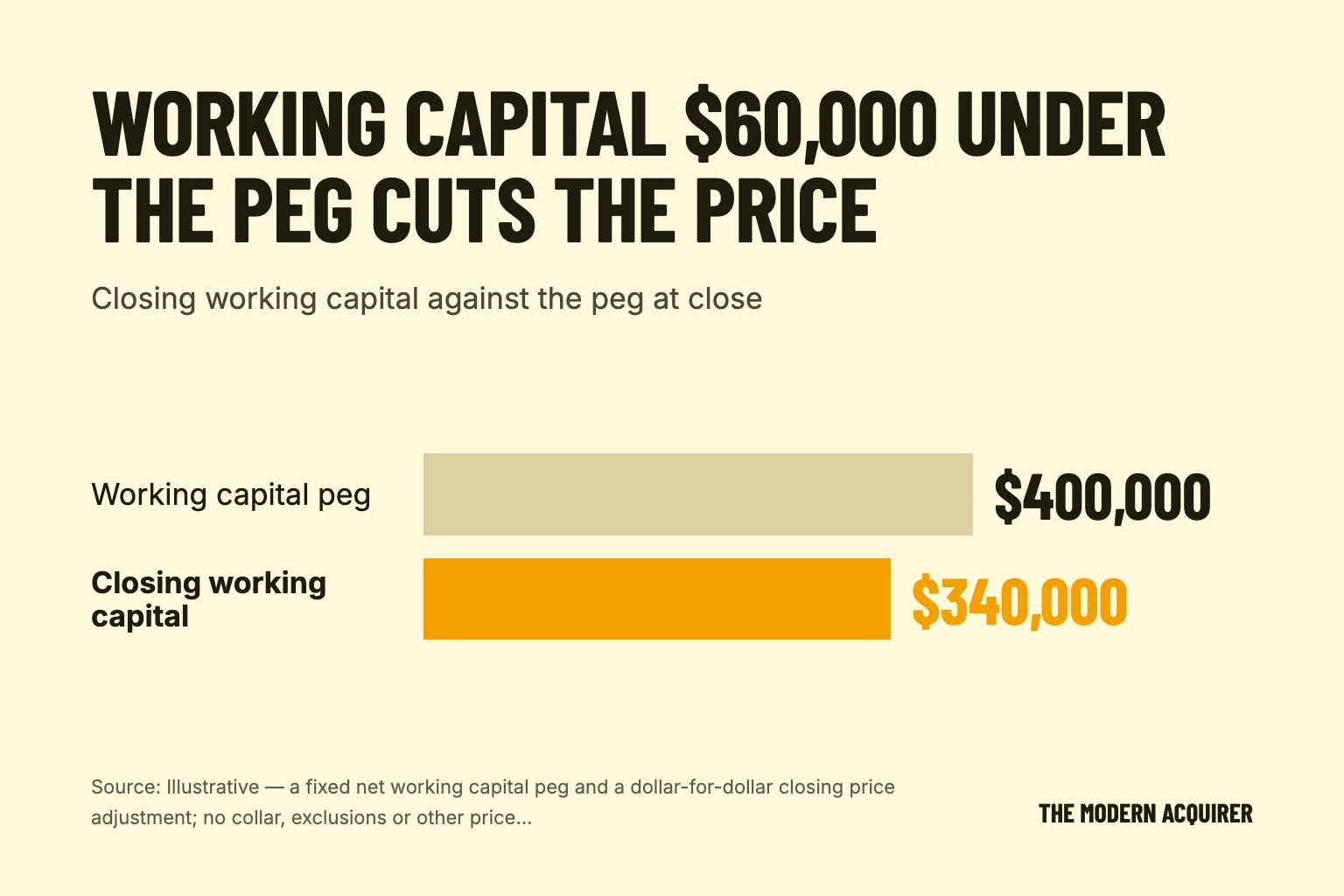
With a $400,000 peg, closing net working capital of $340,000 reduces the price by $60,000. Above the peg, the price rises by the excess.Closing net working capital: $340,000
Price adjustment: −$60,000
Price falls by $60,000.
Source: Illustrative — a fixed net working capital peg and a dollar-for-dollar closing price adjustment; no collar, exclusions or other price adjustments. These are invented agreement inputs, not observed deal data.
Figure data
| Net working capital at close | Adjustment to the price |
|---|---|
| $250,000 | −$150,000 from the price |
| $340,000 | −$60,000 from the price |
| $400,000 | $0 (at the peg) |
| $450,000 | +$50,000 to the seller |
| $550,000 | +$150,000 to the seller |
Illustrative peg of $400,000.
Working capital due diligence starts with keeping the business running
The financial statements describe past activity. As the incoming owner, you need to know what keeps it going. Customer orders consume resources, and those resources often have to be paid for before the related cash arrives.
A quality of earnings practitioner compares it to buying a car: you expect gas in the tank. Paying a multiple of earnings assumes the business arrives with the receivables and inventory it needs to keep producing them.
That changes how you read the balance sheet. A receivable is money a customer owes; it does not cover a payment leaving the bank today. Inventory can support fulfillment, but having it does not mean it suits current demand. A supplier bill is still owed even when the related sale looks profitable.
Use the working capital definition to agree on terms with your advisers. Then connect each accounting category to the work employees do, the supplies they use, and the collections that fund the next round of work.
Keep this inside the broader business acquisition due diligence process. A good answer about profit does not answer a question about cash.
Check receivables and inventory for what they do
A balance at the reporting date is not enough. Ask what each balance contains, what supports it, and how it keeps the business serving customers.
For receivables, ask how the business moves from finished work to invoice to payment. Who confirms work is ready to bill? Who handles customer questions? What leaves an invoice unpaid? The answers separate a routine wait for cash from a problem that could delay it.
Ask about overdue or disputed balances. The seller may have a reasonable explanation, but keep it next to the record that supports it. An expected payment is not cash in the bank.
For inventory, ask how the goods on hand support the orders the business expects to fill. Stock that cannot serve current demand ties up space and cash without doing the same job. Ask whether goods are usable, whether the records match what employees can actually reach, and whether restocking depends on suppliers whose reliability is unclear. A bigger inventory balance is not automatically better.
- Which receivables are awaiting routine payment, and which need explanation?
- What records support collection of disputed or overdue invoices?
- Who owns billing and collection during the handover?
- Which inventory supports current demand, and which needs review?
- What could stop the team from restocking supplies needed to fill orders?
- How do open receivable or inventory questions change the cash picture?
A completed list does not prove the resources are adequate. The answers have to fit together, because customer expectations, supplies, collection risk and bills all hit the same bank account.
Seasonality can change the cash burden
A seasonal business can earn little in some months and still owe the same payroll. A quality of earnings practitioner makes the point that salaried staff still need paying when revenue is thin, so the season in which you take over changes how much cash you need on day one.
Ask how activity moves through the year. Does the company prepare for demand before customers pay? Do purchases and staffing rise ahead of collections? Does a quiet period still require the team and premises?
"The business is seasonal" leaves too much open. Ask what changes, what continues, and which records show the pattern. Strong demand does not mean cash arrives when the preparation costs do.
Employees may describe when work gets busy; the financial records show when payments arrive. If the two accounts disagree, ask your adviser to reconcile them rather than picking the one that makes the business look easier to fund.
Ask whether the recent period was typical. Customer delays, supply problems or unusual activity can distort it. You take over at a particular point in the cycle; know which demands are coming and which collections are uncertain.
Follow the timing of collections and payments
Ask the seller to walk through the sequence from preparing the work to receiving payment, including what gets paid along the way.
The business may have to pay staff and suppliers while invoices are still outstanding. That gap matters even when the work is profitable, and it matters when a comfortable-looking cash balance sits in front of bills nobody has mentioned.
Ask what triggers billing, what can hold up collection, and which payments are needed before the next order can be filled. Keep recorded payments, outstanding invoices and the seller's expectations about collection as three different kinds of information, so an optimistic assumption does not become a fact at handover.
| Area to discuss | Ask about the timing | Record what remains unresolved |
|---|---|---|
| Customer billing needs an owner. | What must happen before the team can issue an invoice? | Note any billing dependency that needs explanation. |
| Collections support operating cash. | What could delay the expected customer payment? | Note which receipt assumptions need supporting records. |
| Inventory supports fulfillment. | When must supplies be available for customer work? | Note any uncertainty about replenishment or usable stock. |
| Payroll continues with operating responsibilities. | How does staffing cash demand relate to customer receipts? | Note which commitments the cash discussion must cover. |
| Supplier payments affect continuity. | What payments support the supplies or services the business needs? | Note any obligation whose timing remains unclear. |
The table is a conversation aid, not a formula. Businesses collect and pay in different ways; what you want is a coherent account of the cash cycle you are inheriting.
Carry the findings into cash planning
Findings that stay in a report the new operator cannot use are wasted. A practitioner who has bought businesses says closing can feel like the easy part compared with running the company afterward, when the new owner has to watch the bank balance and build a cushion. He ties quality of earnings work to operating cash planning after the handover.
The handover should explain where cash is expected to come from, what consumes it, and which assumptions could change. A customer payment that was uncertain in diligence should stay uncertain in the cash plan. A seasonal build-up should stay in view.
A forecast makes expectations easier to examine. It cannot make an uncertain receipt certain. Ask what supports the cash picture, who keeps it current, and who can explain a gap between what was expected and what arrived.
The person who prepares the accounts may not handle collections or purchasing. Ask who understands each part of the cash cycle and how that knowledge reaches the new operator. Use the acquisition transition plan to connect findings to the handover.
Keep open cash questions visible
Before calling the review done, read your notes as the person who has to keep customers served. Can that person say where cash comes from, what the business must pay, and what is still uncertain? If the answer rests on a seller's assurance, note what would support it.
Write specific questions. "Will this customer payment arrive before payroll is due?" is more useful than "working capital needs attention". "Who can explain stock that cannot fill current orders?" gives the next conversation a purpose.
An unanswered question needs follow-up; it does not mean something is wrong. A plausible answer without support is still an assumption.
Source notes
The practitioner remarks come from interviews on The SMB Investor podcast and are paraphrased; examples are our own.