Seller Add-Backs: Savings That May Disappear
By Nick Bryant, Co-Founder and CTO, SMB Investor Network
5 min read
In brief
Review seller add-backs for missing support, changing costs, and owner responsibilities. Mark uncertain savings for an accounting review before buying.
Seller add-backs are expenses the seller adds back to reported earnings to show what the business could earn under different circumstances. The risk is paying for a saving that has never been tested as if it were earnings the business already produces. Before you rely on an adjustment, ask what the expense paid for, whether that work has to continue, and who will pay for it after the sale.
Which add-backs survive the review?
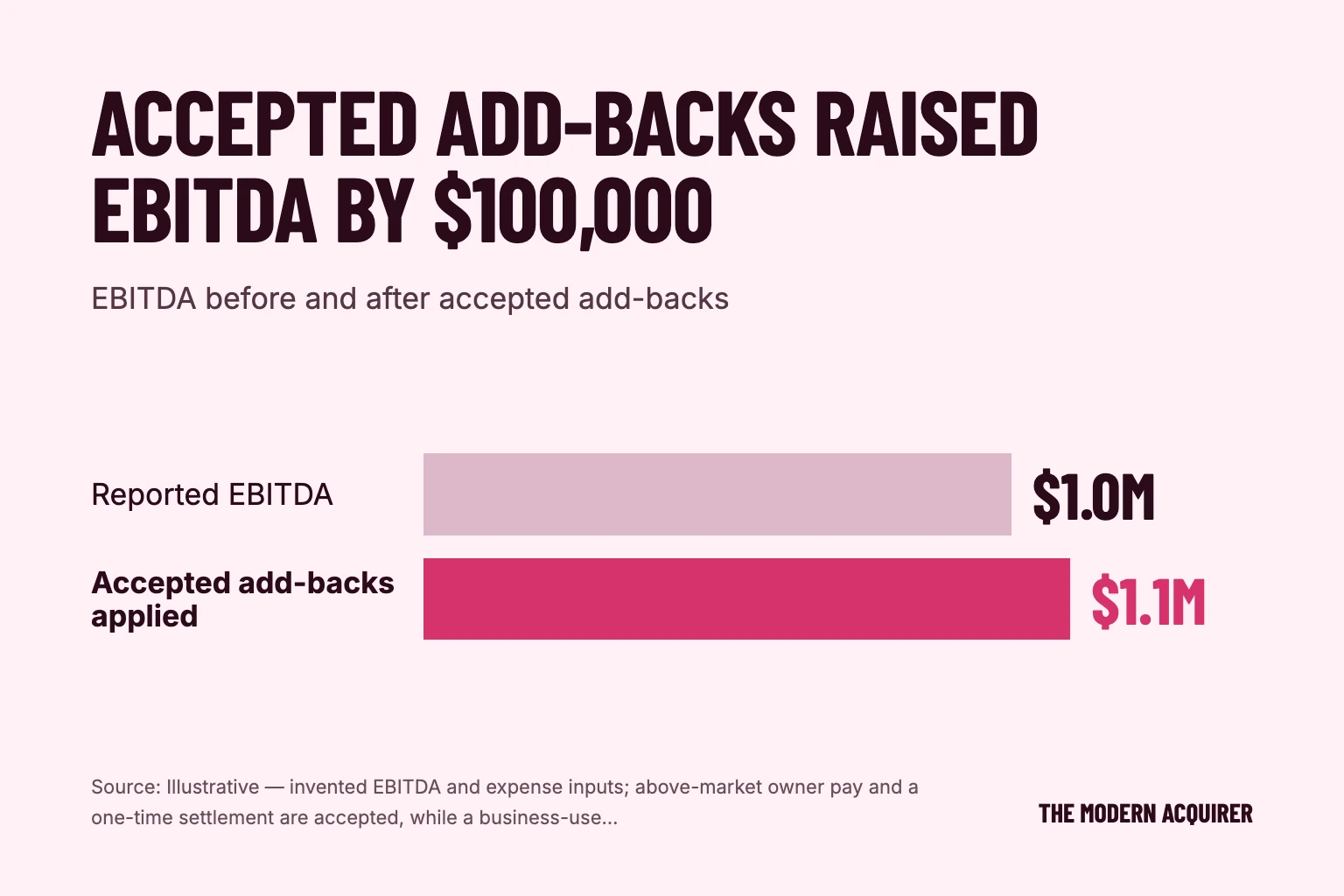
Reported EBITDA of $1,000,000 rises by accepted add-backs of $60,000 and $40,000 to $1,100,000. Rejected vehicle and marketing add-backs of $25,000 and $50,000 leave the total unchanged, below the seller’s $1,175,000 figure.Each stage uses the same dollar scale, from $0 to $1175k.
Reported EBITDA: $1000k
Starting earnings
Owner salary above market: +$60k
Accepted — Above-market portion only
Running EBITDA: $1060k
One-time legal settlement: +$40k
Accepted — Assumed nonrecurring
Running EBITDA: $1100k
“Personal vehicle”: +$25k
Rejected — Still used in the business
Running EBITDA: $1100k
“Marketing we will not need”: +$50k
Rejected — The revenue depends on it
Running EBITDA: $1100k
Adjusted EBITDA: $1100k
Accepted add-backs only
Dashed ghost line: seller’s adjusted figure $1175k.
Filled steps increase EBITDA. Dashed outlines are rejected and leave the running total unchanged.
Source: Illustrative — invented EBITDA and expense inputs; above-market owner pay and a one-time settlement are accepted, while a business-use vehicle and revenue-supporting marketing continue. No other adjustments; not observed deal data.
Figure data
| Item | Amount | Survives review? | Why |
|---|---|---|---|
| Reported EBITDA | $1,000,000 | — | — |
| Owner salary above market | $60,000 | Yes | Above-market portion only |
| One-time legal settlement | $40,000 | Yes | Assumed nonrecurring |
| Personal vehicle | $25,000 | No | Still used in the business |
| Marketing we will not need | $50,000 | No | The revenue depends on it |
| EBITDA as claimed | $1,175,000 | — | All add-backs accepted |
| EBITDA after review | $1,100,000 | — | Accepted add-backs only |
Illustrative business.
What seller add-backs claim
An expense sits in the accounts because the business paid it. An add-back changes how the earnings are presented after that cost. There may be a good reason for it, but its place on the seller's schedule doesn't mean you can remove the expense.
Ask what makes the adjusted earnings different from the reported earnings. Is the seller describing spending unrelated to operations? Does the explanation depend on a change the buyer hopes to make? Does the work continue after the person who paid for it leaves?
Start from the definition of add-backs, then tie each proposed adjustment to the underlying expense and the reason for treating it differently. "Discretionary spending" doesn't answer the operating question. A seller can sincerely believe a cost will stop without ever having tested what happens when it does.
Did the expense help generate sales?
Travel and marketing are where this bites. A seller may call a trip optional because they enjoyed it, when the trip also included a customer visit. Advertising may feel wasteful to the seller and still bring in inquiries.
For each adjustment, check whether the expense will actually stop after the sale or whether the work or cost will need replacing. Interest and depreciation are added when calculating EBITDA from earnings that include those charges; they cannot be added again to the EBITDA used for an adjusted figure. Costs clearly unrelated to the business are easier to support. Travel and marketing a seller says you can cut without hurting revenue are the speculative end. If the spending may have helped produce the earnings you're buying, treat the saving as possible upside, not as earnings the deal depends on.
Ask what happened because the money was spent. Did someone meet customers, keep a relationship going, or bring in demand? Which records link the activity to sales? If the answer is unclear, write it down as unclear. Missing evidence doesn't prove the expense was useless, and a customer connection doesn't prove every dollar was needed.
Your own plans cause the same problem. You may expect to sell more efficiently or replace an expensive activity with something cheaper. That's a change you intend to make, it still has to be done, and it may affect customers. Keep it labeled as your assumption, separate from the business's existing earnings.
Seller add-backs can hide costs that go up
The review also has to catch costs that will rise. A historical expense can reflect the seller's personal relationship with a supplier, a handshake discount, or property the seller owns. The question is whether the next owner can run the business on the same costs.
Review spending by vendor and ask the seller to explain anything that depends on a personal relationship. What makes the current price available? What's known about whether it continues? Keep those answers with the expense records so the accountant can see them.
Premises need the same attention. If the seller owns the building and plans to lease it to you, the rent in the historical accounts may not be the rent you'll pay. Settle the rent in the letter of intent and make sure the earnings analysis reflects it.
A presentation can highlight proposed savings while leaving rising costs out. Read the adjustments against the continuing cost base before drawing any conclusion from them.
Who will do the seller's work?
The owner leaves; the work doesn't. Customer calls, staff supervision, purchasing and problem-solving still need someone. Taking the owner's pay out of the earnings doesn't say who will do any of it.
Suppose a business's working owner has been paid through distributions. The profit figure may then hide how much labor a buyer will have to replace. A buyer values what's left after paying for that work.
Start with what the owner actually does, not their title. Which customer relationships involve the seller? Which decisions do staff bring to them? What stops when they're away? Some of that work has no obvious replacement role today.
If you plan to do the work yourself, write down what you're taking on and whether it fits with everything else you'll be doing. Being willing to work doesn't mean you have the skills, contacts or hours.
An operator buying an add-on has the same problem when expecting an existing team to absorb the work. Which responsibilities move, and who has the capacity? A plan to share staff needs that answer before it supports a saving.
That makes owner dependence part of the add-back review. Keep the seller's current contribution, the proposed replacement and the open questions in front of whoever is assessing the earnings.
Connect adjusted earnings to the cash the business needs
Adjusted earnings don't tell you when customers pay or when the business has to pay its bills. Don't let confidence in an earnings presentation stand in for that review.
The quality of earnings guide puts adjustments in the wider earnings review. Take the cash questions into working capital due diligence. A plan to switch suppliers, for example, may change payment terms as well as price, so a cheaper option isn't automatically better for cash.
Mark unsupported add-backs for independent accounting review
An adjustment schedule is more useful when the explanation and the missing support travel with it. You don't need a rating system. Write down what the seller claims, what records exist, and what you need an independent accountant to examine.
- Identify the expense being adjusted and where it appears in the records.
- Write down the seller's reason the expense would change.
- Ask what activity the spending supported and whether that activity has to continue.
- Note whether the explanation depends on customer behavior or a seller-specific arrangement.
- List the owner's remaining responsibilities and who would take them on.
- Mark gaps in the records and assumptions nobody has checked.
- Ask the accountant what is still unresolved after their review.
Keep the seller's explanation separate from your own planned improvements. Mix them and the accountant may end up assessing a claim neither of you made.
When evidence changes the picture, update the note. An expense may turn out to support customers, or the owner's job may be bigger than it looked. Don't let an earlier description survive because everyone has got used to it.
If you can't explain why an expense would disappear without hurting the business, keep it marked as unsupported. A polished earnings presentation doesn't remove the need for that explanation.
Source notes
The owner-replacement example and other examples are illustrative.