When the Biggest Customer Leaves: Due Diligence Questions
By Nick Bryant, Co-Founder and CTO, SMB Investor Network
6 min read
In brief
Customer concentration due diligence: why the biggest customers buy, who keeps them, and who wins new work once the seller leaves.
When one customer pays a large share of the bills, the buyer's risk is simple: you assume last year's sales will continue after the seller leaves, and they don't. Customer concentration due diligence asks why the biggest customers buy, who keeps them, and what happens to the business if one walks.
The day the largest customer leaves
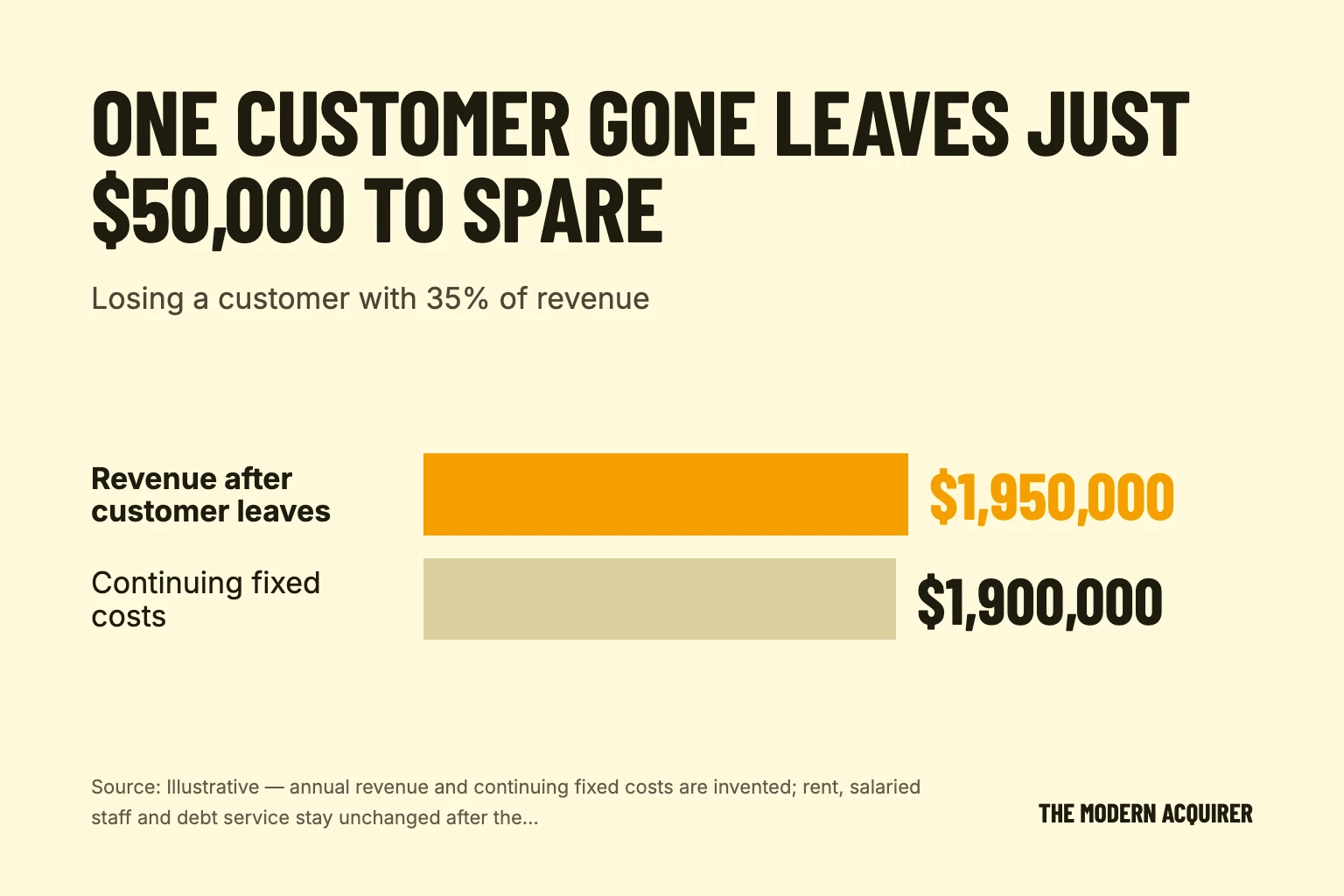
With annual revenue of $3,000,000 and a largest customer share of 35%, losing that customer leaves $1,950,000, only $50,000 above $1,900,000 in continuing annual fixed costs.Revenue if the largest customer leaves: $1,950,000/year
Ruled line and lower bar: continuing fixed costs $1,900,000/year.
Filled: retained revenue. Dashed outline: lost revenue $1,050,000/year (35%).
Margin to fixed costs: +$50,000/year
Remaining revenue covers fixed costs with $50,000 to spare.
Source: Illustrative — annual revenue and continuing fixed costs are invented; rent, salaried staff and debt service stay unchanged after the customer leaves, with no replacement revenue. Variable costs are excluded, so the margin shown is not profit.
Figure data
| Largest customer’s share of revenue | Revenue lost | Revenue remaining | Margin to fixed costs |
|---|---|---|---|
| 10% | $300,000 | $2,700,000 | $800,000 |
| 20% | $600,000 | $2,400,000 | $500,000 |
| 30% | $900,000 | $2,100,000 | $200,000 |
| 35% | $1,050,000 | $1,950,000 | $50,000 |
| 40% | $1,200,000 | $1,800,000 | -$100,000 |
| 50% | $1,500,000 | $1,500,000 | -$400,000 |
| 60% | $1,800,000 | $1,200,000 | -$700,000 |
Illustrative: $3,000,000 annual revenue, $1,900,000 continuing fixed costs a year.
For example, suppose the largest customer leaves. Revenue falls at once, while rent, salaried staff, and debt service may continue. Ask whether the remaining work can cover those obligations while the business replaces the customer. If the purchase is SBA-financed, what SBA's own loan data says about acquisition loans gives context on loan outcomes. It does not show whether a concentrated customer base will survive a sale.
A customer list doesn't verify revenue
Customer-level revenue records show where the business depends on particular buyers; a list of names alone cannot. Those records don't show that the reported revenue was received, or that the same customers will need the same work under a new owner.
In an interview on The SMB Investor podcast, a quality of earnings practitioner starts revenue diligence by checking that reported sales actually show up in bank deposits. Only then does he look at concentration and repeat business. Those are separate weaknesses: a clean payment history says nothing about how exposed you are if the biggest customer leaves.
When a seller calls a customer "established and reliable", ask what they mean. It could be a history of paying invoices, a habit of coming back, or a personal relationship with the owner. Each leads to a different question, and the same adjective covers all three.
Proof that customers paid for completed work supports the receipts. It doesn't show another order is coming. Proof of repeat purchases shows customers came back. It doesn't show whether the seller had to win each order again.
The revenue quality diligence guide covers what revenue may survive a sale. Keep concentration as its own line in that review. Otherwise confidence in the financial records turns into confidence in customer continuity, with nothing connecting the two.
Examine the relationships behind customer concentration
The customer's name is where the work starts. Who hears about the next job? Who understands what the customer needs? Who picks up the phone when the customer is unhappy or the work changes?
A seller may call a customer loyal to the business. Ask what shows that. Does the customer deal with the team, or does the owner still interpret requests and settle complaints? A familiar name doesn't tell you where the trust sits.
Delivering work and keeping a relationship are different jobs. An employee may do excellent work while the owner stays the customer's contact. Another may handle routine emails while the seller handles the conversations that decide whether more work follows.
Seller involvement alone isn't always a reason to walk away. But if major customer relationships depend on a departing owner, that can be a reason to stop pursuing the deal. Your job is to find out whether the team has shown it can do what you need it to do after the sale.
| When the seller says | Ask |
|---|---|
| Customers know the team. | Which employees handle requests and discuss future work with customers? |
| Customers trust the business. | What shows that trust extends beyond the owner? |
| The owner rarely handles delivery. | Who has the conversations that lead to the next purchase? |
| Relationships should continue. | How do those relationships work when the seller isn't there? |
A contact list isn't proof of continuity. Knowing whom to call is different from knowing why they choose the business.
If the same employee or the owner keeps coming up in explanations of how customers are kept, read the key person risk guide alongside this one.
Read repeat purchasing as history, not a forecast
A returning customer is something to investigate: a record of choosing the business again. Regular orders and occasional return projects are different patterns, and neither tells you what the customer will buy after an ownership change.
The definition of repeat revenue keeps the language straight. A customer can come back without the next purchase being automatic. When a seller calls the customer base recurring, ask what buying behavior the word describes.
Take a customer who comes back whenever a new project comes up. The relationship continues, but the business still has to understand the project, write a proposal, and win the work. Another customer places similar orders as part of their own operations. That raises a different question: what need drives the orders, and who looks after the relationship around them?
Gaps in the history need explaining too. A quiet year could mean the customer had no need, bought elsewhere, or is still active with nothing recent to order. If the records can't tell you which, leave the question open.
Check that the seller's description matches the purchase record. A seller may remember a customer as longstanding while the recent work looks nothing like the work that started the relationship.
Ask who wins new sales after the seller leaves
Keeping existing customers and winning new work are different jobs. A business can serve its current customers well while relying on the owner to bring in the next project.
The same interview makes the point directly: buying the business doesn't transfer the seller's ability to sell. Running operations and winning customers are separate skills, and the difference matters most when every finished project has to be replaced with a new one.
Ask how work comes in. Does the owner find the opportunity, take the inquiry, shape the proposal, or close the customer? Does the team do any of that on its own, or support a process the seller still runs?
Stick to actual responsibilities. A salesperson's title doesn't say which conversations they handle. An owner who says "the team handles sales" may still be the person customers want to hear from before they agree.
Long-standing customers can hide this. A familiar buyer may still expect the seller to discuss the next job, and each new order may depend on someone who's leaving.
Be honest about your own role. If you plan to run operations, who will sell? If you plan to take over customer conversations yourself, what knowledge and relationships do those conversations need that you don't have yet?
If you're an operator buying an add-on, your existing sales team may help. Having salespeople doesn't mean they understand the acquired business's customers.
Keep unanswered customer questions visible
A summary that calls the customer base "attractive", "established" or "repeat" can quietly erase the open questions underneath. Keep them.
Separate what the records show from what someone expects. The history may show a customer came back. The seller may expect them to come back again. Your notes should keep those apart so an expectation doesn't become a finding by repetition.
Before the next discussion with your advisers:
- What does the concentration figure show, and what doesn't it answer?
- Have you separated evidence of receipts from evidence of customer continuity?
- Can you describe how customers have bought without assuming the pattern continues?
- Do you know who keeps the relationships and who wins new work?
- Where does the seller's explanation still need supporting records?
- Which assumptions about your own ability to sell are untested?
Where accounts differ, write the disagreement down plainly. The seller may say a customer belongs to the team while every example shows the owner handling the important conversations. That's a relationship you need to understand before you price it.
The business acquisition due diligence guide puts these questions alongside the rest of the review. Don't let a good finding elsewhere answer them by implication.
Source notes
Guest remarks from an interview on The SMB Investor podcast are paraphrased; the example is illustrative and our own.