What SBA Acquisition Loan Approvals Tell a Buyer
By Nick Bryant, Co-Founder and CTO, SMB Investor Network
7 min read
In brief
A full pass over SBA loan-level data: how big acquisition lending got, who lends, which loans fail, and what to watch around the October 2026 rule change.
Some SBA acquisition loans charge off years after approval, and smaller loans have charged off more often12. In FY2026 through June, 26.4% of funded 7(a) loan dollars went to change-of-ownership loans3.
Change-of-ownership loans made up 26.4% of funded 7(a) dollars in the year to date, up from 15.6% in FY20183. I pulled SBA's own loan-level FOIA files and counted 50,942 change-of-ownership approvals since FY20184. My FY2025 count from the FOIA file is 78,078 loans and $37.29B5; SBA's FY2025 release reports 77,600 loans and $37 billion6. The method notes are below.
How big acquisition lending got
FY2025 booked 7,533 change-of-ownership approvals worth $8.82B5. That share of 7(a) dollars has climbed from 15.6% in FY2018 to 26.4% in the FY2026 year to date3. The median funded loan has grown alongside it: $479,800 in FY2018, $700,650 in FY2025, $721,750 so far in FY20267.
Break the size bands down and the middle of the market is bigger than a small-loan story suggests. From FY2024 through June 2026, 30% of funded change-of-ownership loans came in at or under $350K, 11% between $350K and $500K, 22% between $500K and $1M, 19% between $1M and $2M, and 16% between $2M and $5M, with 2.3% hitting the $5M program cap8. The median loan in that window was $693K8.
Takeaway: the median SBA acquisition loan is about $700K now7.
What buyers actually buy with it
By count, retail leads at 17.1% of change-of-ownership loans, followed by accommodation and food service at 16.5%, other services at 10.9%, and construction at 10.6%9. Drop to the six-digit NAICS level and the list reads like Main Street: full-service restaurants, limited-service restaurants, hotels and motels, liquor retailers, gas stations with convenience stores, specialty trades, auto repair, plumbing and HVAC, landscaping, and child care10. Franchises are 14.1% of the total, a real share but a minority11.
If your comp set is software companies or anything venture-shaped, it's the wrong comp set for this loan program. The SBA acquisition buyer is buying a hotel, a landscaping company, or an auto repair shop, and the underwriting reflects that. For example, a lender who has closed a dozen limited-service restaurant loans has a mental model for that business's margins and seasonality; a lender who has never seen the category is pricing risk blind, on both sides of the table.
That has a practical consequence for search criteria. If you're looking at a category with few precedent loans in this dataset, ask lenders how they assess that kind of business. SOP 50 10 8.1 takes effect October 1, 202612; ask which DSC floor applies to your acquisition type13.
Takeaway: the SBA buyer market is Main Street, not software. Your comps are here.
Who lends
988 lenders wrote change-of-ownership loans in this window, but the market is concentrated at the top14. Huntington and Live Oak alone made 21.3% of all loans between them, and the top ten lenders made 35.1%14. Most of that volume, 75.6%, moves through delegated Preferred Lender Program authority, with another 15.5% through SBA Express11.
A small group of lenders has therefore handled far more change-of-ownership loans overall14. That may be worth a phone call before you write an LOI, not after; their volume alone says nothing about experience with your industry, loan size, or specific deal. Delegated PLP authority means these lenders can approve a loan against SBA's rules without SBA reviewing every file first, which can be faster for you if the lender is comfortable with your deal shape.
A relationship banker who has never closed a change-of-ownership 7(a) loan isn't the wrong person to talk to, but treat their first answer as a starting point, not a verdict. Ask directly how many change-of-ownership loans they closed in the last year, in what size range, and in what industries.
Takeaway: the top ten lenders made 35.1% of these deals14. Talk to an experienced lender before the LOI.
Which acquisition loans fail
Which acquisition loans fail
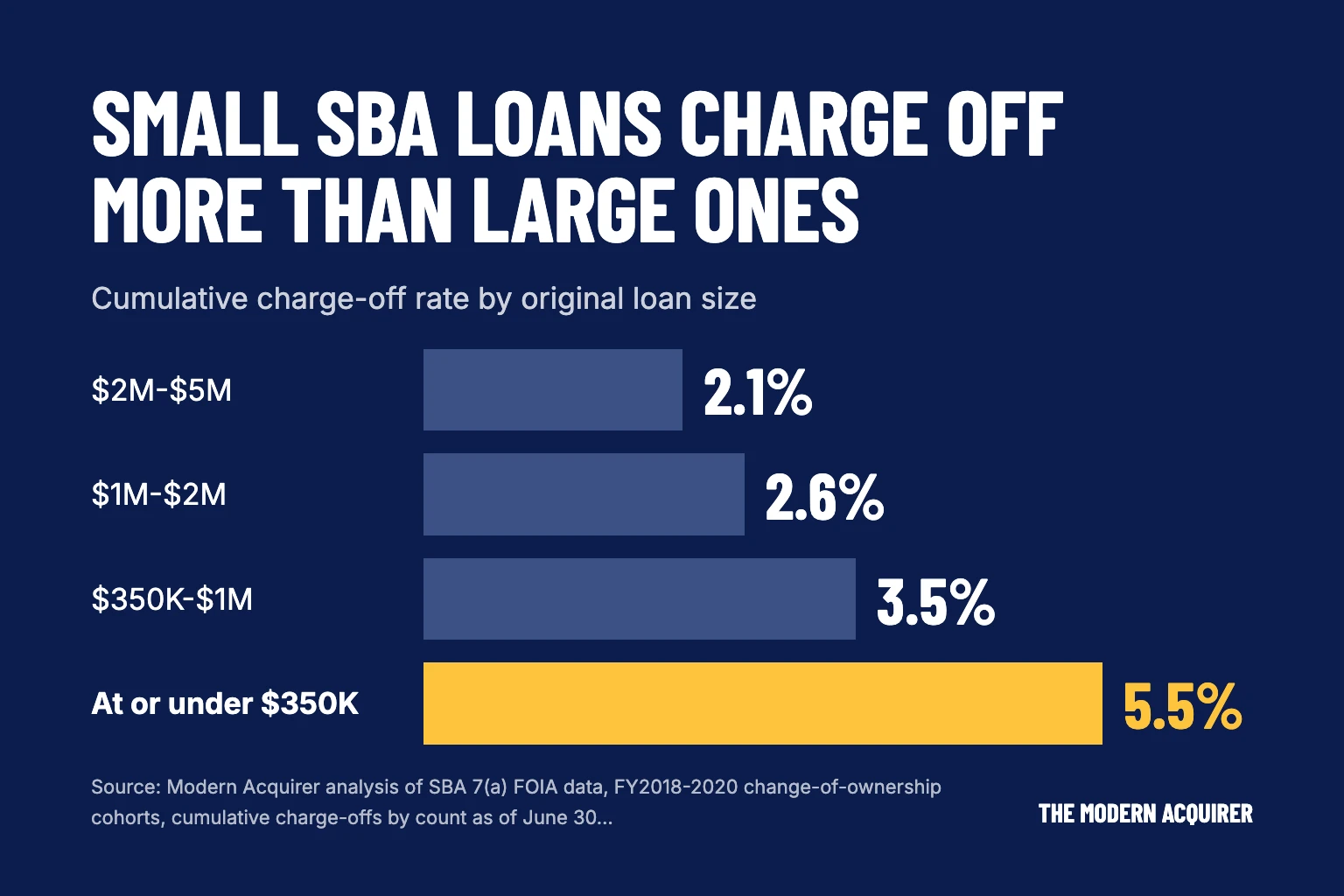
By loan size, cumulative charge-off rate: at or under $350K 5.5%, $350K to $1M 3.5%, $1M to $2M 2.6%, $2M to $5M 2.1%. By industry: arts and recreation 8.9%, transport 5.4%, accommodation and food service 4.4%, construction 4.4%, admin and support 4.3%, other services 4.1%, retail 3.4%, professional services 2.9%, health care 2.2%. When a loan fails, the median loss is 76% of its original amount.By loan size
By industry (FY2018-20 cohorts)
When one fails, the median loss is 76% of the loan.
Source: Modern Acquirer analysis of SBA 7(a) FOIA data, FY2018-2020 change-of-ownership cohorts, cumulative charge-offs by count as of June 30, 202611516. A floor: active loans are withheld as EXEMPT and failures surface around month 50. Pandemic-era payment relief (2020-21 cohorts) affects these years17.
Figure data
| Group | Cumulative charge-off rate |
|---|---|
| Loan size: $2M-$5M | 2.1% |
| Loan size: $1M-$2M | 2.6% |
| Loan size: $350K-$1M | 3.5% |
| Loan size: At or under $350K | 5.5% |
| Industry: Health care | 2.2% |
| Industry: Professional services | 2.9% |
| Industry: Retail | 3.4% |
| Industry: Other services | 4.1% |
| Industry: Admin and support | 4.3% |
| Industry: Construction | 4.4% |
| Industry: Accommodation and food service | 4.4% |
| Industry: Transport | 5.4% |
| Industry: Arts and recreation | 8.9% |
| Median loss on a failed loan, share of original amount | 76% |
By count, change-of-ownership loans charge off less often than other 7(a) categories: 3.2% versus 4.9% for existing-business loans and 5.6% for startups, in the FY2018-21 cohorts18. That's the reassuring headline, and it's also where most recaps stop.
Split the FY2018-20 cohorts by size and the pattern flips. Loans at or under $350K charge off at 5.5%, falling to 3.5% for $350K-$1M, 2.6% for $1M-$2M, and 2.1% for $2M-$5M1. By industry, arts and recreation charges off at 8.9%, transport at 5.4%, and accommodation and food service and construction both at 4.4%, against 2.2% for health care15. And when a change-of-ownership loan does fail, the median gross charge-off is 76% of its original approved amount, with a median charge-off around $278K, before any later recovery16.
Timing matters just as much as the rate. The median gap between approval and charge-off is 50 months, with the middle half of failures landing between 38 and 66 months2. Recent cohorts' ultimate charge-off rates remain unknown2. Here's how reading this data goes wrong:
- Treating recent cohorts' charge-off rates as final, when failures typically don't surface until around month 502.
- Comparing charge-off rates by count when your personal guaranty is exposed to dollars, and dollar-weighted rates tell a different story1816.
- Ignoring that some borrowers eligible under the CARES Act and its later extension received SBA payment relief; the extension was prorated, so relief varied by loan17.
- Reading a loan coded "EXEMPT" as healthy, when that status in these files does not rule out a later charge-off19.
Takeaway: smaller loans charge off most often, and gross losses on failed loans are large116.
Approvals around the rule changes
Rule changes move acquisition lending within a month
Monthly change-of-ownership 7(a) approvals, January 2023 through June 2026, ran roughly 350 to 750 a month with September fiscal-year-end spikes, until May 2025's rush to 929 approvals ahead of SOP 50 10 8, June 2025's drop to 365 the month the rule took effect, zero approvals in October 2025 during the federal shutdown, and a rebound with a likely backlog in January 2026. Median loan size rose alongside the June 2025 rule change, from about $676,000 to about $750,000.Columns: monthly approvals (left axis, 0 to 967). Line: median loan size (right axis, $522k to $845k).
Oct 1, 2026: SOP 50 10 8.1 is the next rule change; watch that month's data the way this chart shows May and June 2025.
Source: Modern Acquirer analysis of SBA 7(a) FOIA data, change-of-ownership approvals, as of June 30, 202642021. Counts include loans later cancelled, to match SBA's own headline figures.
Figure data
| Month | Change-of-ownership loans approved | Median loan | Note |
|---|---|---|---|
| Jan 2023 | 353 | $650,000 | |
| Feb 2023 | 344 | $675,550 | |
| Mar 2023 | 419 | $587,400 | |
| Apr 2023 | 375 | $600,000 | |
| May 2023 | 390 | $599,050 | |
| Jun 2023 | 385 | $655,000 | |
| Jul 2023 | 398 | $717,500 | |
| Aug 2023 | 418 | $546,000 | |
| Sep 2023 | 712 | $656,500 | |
| Oct 2023 | 316 | $673,000 | |
| Nov 2023 | 458 | $785,000 | |
| Dec 2023 | 493 | $550,000 | |
| Jan 2024 | 444 | $596,250 | |
| Feb 2024 | 462 | $600,000 | |
| Mar 2024 | 531 | $750,000 | |
| Apr 2024 | 495 | $617,000 | |
| May 2024 | 515 | $557,400 | |
| Jun 2024 | 512 | $656,500 | |
| Jul 2024 | 561 | $651,800 | |
| Aug 2024 | 561 | $640,400 | |
| Sep 2024 | 706 | $810,000 | |
| Oct 2024 | 525 | $522,000 | |
| Nov 2024 | 472 | $675,000 | |
| Dec 2024 | 746 | $685,250 | |
| Jan 2025 | 592 | $634,400 | |
| Feb 2025 | 571 | $725,400 | |
| Mar 2025 | 864 | $597,000 | |
| Apr 2025 | 468 | $668,650 | |
| May 2025 | 929 | $791,000 | 929, last month under 8.0 |
| Jun 2025 | 365 | $840,000 | 365, SOP 8 effective |
| Jul 2025 | 559 | $825,900 | |
| Aug 2025 | 536 | $704,500 | |
| Sep 2025 | 906 | $813,750 | FY-end push |
| Oct 2025 | 0 | — | 0, shutdown |
| Nov 2025 | 538 | $712,000 | |
| Dec 2025 | 615 | $845,000 | |
| Jan 2026 | 967 | $700,500 | shutdown backlog |
| Feb 2026 | 441 | $708,000 | |
| Mar 2026 | 495 | $745,500 | |
| Apr 2026 | 573 | $696,600 | |
| May 2026 | 506 | $758,750 | |
| Jun 2026 | 637 | $675,000 |
| Month | Change-of-ownership approvals |
|---|---|
| May 2025, before SOP 50 10 8 | 92920 |
| June 2025, when SOP 50 10 8 took effect | 36520 |
| October 2025, during the shutdown | 021 |
The monthly data changed around the rule change, though timing alone cannot show why. May 2025 booked 929 change-of-ownership approvals, the month before SOP 50 10 8 took effect. June 2025, the first month under the new rule, booked 36520. Median loan size moved too, from about $676K in the eleven months before the rule to about $750K after it20.
October 2025 shows zero approvals, not because demand vanished but because the federal government shut down and SBA couldn't process loan numbers from October 1 through November 1221. The shutdown makes month-to-month comparisons misleading.
SOP 50 10 8.1 takes effect October 1, 202612. For Initial Acquisitions it raises the SBA's minimum DSC from 1.15x to 1.25x and stops lenders from meeting it with projections, except for owner-occupied Special Purpose Property deals13. Compare the monthly approvals after that date with earlier months, while accounting for other changes that could affect volume.
Takeaway: monthly volume changed around the 2025 rule date20. Watch the October 2026 data when it posts without assuming the rule caused any change.
What I'd do
- Pull your industry from the failure-rate chart before you fall for a listing. If its historical charge-off rate is high, ask what drove it and whether those conditions apply to the business15.
- Treat a sub-$350K deal as the riskiest shape in this data, not the safest entry point. Small loans failed most often, by a wide margin1.
- Read the 76% median gross charge-off figure16 next to the personal guaranty you're about to sign. It measures the loan's gross charge-off relative to the original approved amount, including guaranteed and unguaranteed portions, before any later recovery; it is not a measure of your personal loss.
- Ignore any "SBA acquisition loans barely default" claim built on 2023-25 cohorts. Their ultimate charge-off rates remain unknown2.
- Call two of the high-volume lenders before you sign an LOI. Ask about their experience with your industry, loan size, and deal shape; overall acquisition-loan volume alone does not establish it14.
- Re-run these numbers when SBA posts the October-December 2026 file. That's the first file that can include loans underwritten to 8.1, though it won't say which rule governed each loan12.
Method notes
"Change of ownership" is SBA's own BusinessAge category, entered by the originating lender; it isn't coded before FY20184, and some acquisitions may still be coded "Existing" if a lender didn't tag it. Approval counts and totals, including FY2025's $8.82B, include loans later cancelled5. Funded-dollar shares, median funded loan sizes, and the FY2024-June 2026 size bands exclude cancellations378. For charge-off rates, the analysis excludes cancelled and undisbursed term loans. The June 30, 2026 files used here still code charge-offs as CHGOFF and active loans as EXEMPT; they contain no CLSLN or SOLDCO statuses. An April 2026 release introduced those split codes22, so analyses of files using them must count those charge-off codes too. These rates count CHGOFF, are cumulative to June 30, 2026, and cannot establish recent cohorts' ultimate rates19115182. EXEMPT is not a clean bill of health19. Gross charge-off is measured before any recovery from guarantors or collateral sales16. FY2026 in this dataset runs November 13, 2025 through June 30, 2026 only, reflecting the shutdown delay421.
For the capital-stack mechanics this data sits inside, the SBA acquisition capital stack after October 2026 walks a worked deal through the new DSC floor. SBA acquisition loan preparation covers what to bring to the lender conversation, and customer concentration due diligence covers a separate diligence question this loan data does not measure.
Source notes
Except for SBA's published FY2025 totals6, the figures are The Modern Acquirer's analysis of SBA's public 7(a) FOIA loan-level data (files as of June 30, 20264). Download the current source files from SBA to examine the underlying loan records. Lender counts (Huntington, Live Oak) are factual volume figures, not a ranking or an endorsement. Charge-off is not the same as default, and none of this data assigns a failure probability to any one loan.
Sources
- Modern Acquirer analysis of SBA 7(a) FOIA data as of 2026-06-30 ↑
- Modern Acquirer analysis of SBA 7(a) FOIA data as of 2026-06-30 ↑
- Modern Acquirer analysis of SBA 7(a) FOIA data as of 2026-06-30 ↑
- SBA Open Data, 7(a) & 504 FOIA dataset (FOIA_7a_FY2010_FY2019 and FOIA_7a_FY2020_Present, asof 260630); Modern Acquirer analysis ↑
- Modern Acquirer analysis of SBA 7(a) FOIA data as of 2026-06-30 (approvals incl. later-cancelled loans) ↑
- U.S. Small Business Administration, news release 25-83 ↑
- Modern Acquirer analysis of SBA 7(a) FOIA data as of 2026-06-30 ↑
- Modern Acquirer analysis of SBA 7(a) FOIA data as of 2026-06-30 ↑
- Modern Acquirer analysis of SBA 7(a) FOIA data as of 2026-06-30 (2-digit NAICS) ↑
- Modern Acquirer analysis of SBA 7(a) FOIA data as of 2026-06-30 (6-digit NAICS) ↑
- Modern Acquirer analysis of SBA 7(a) FOIA data as of 2026-06-30 ↑
- SBA Information Notice 5000-880695, Issuance of SOP 50 10 8.1 ↑
- SBA SOP 50 10 8.1, Appendix 15, Lender's Credit Analysis; SBA SOP 50 10 8.0 (technical updates effective 6/1/2025), Debt Service ↑
- Modern Acquirer analysis of SBA 7(a) FOIA data as of 2026-06-30 ↑
- Modern Acquirer analysis of SBA 7(a) FOIA data as of 2026-06-30 ↑
- Modern Acquirer analysis of SBA 7(a) FOIA data as of 2026-06-30 ↑
- SBA Procedural Notice 5000-20079 and related Section 1112 guidance ↑
- Modern Acquirer analysis of SBA 7(a) FOIA data as of 2026-06-30 ↑
- Modern Acquirer analysis of SBA 7(a) FOIA data as of 2026-06-30 (term loans, excl. cancelled/undisbursed) ↑
- Modern Acquirer analysis of SBA 7(a) FOIA data as of 2026-06-30 ↑
- NAGGL, 'The Government Reopens After Longest Shutdown in History'; SBA 7(a) FOIA data ↑
- LoanTape, "SBA Loan-Level Delinquency Is Public for the First Time" (Apr 30, 2026) ↑